At the start of class we started going over our homework from monday night. We went from the bottom to the top. The first answer to the question "what does you are what you eat mean?" was that the mass of the food that you eat is the mass of the body weight. The second question what "why must the equations be equal?" The answer to that was because the stuff can't dissapear. So it all has to be equal. An example was a chocolate chip cookie. Once you put chocolate chips in the dough and then bake it the same amount of chocolate chips are in it. The equations we went over were all equal. If you have any questions on the homework go see Mr. Finley for help. Here is the link for the homework we had monday night. Print out the sheet if you need help.
http://www.npsd.k12.nj.us/20222069133223760/assignments/browse.asp?C=59836&A=400&DomainID=2556&AssignmentID=2807&AssignmentCategoryID=0&Month=0&Year=0
-Simrin
Thursday, January 13, 2011


Monday, January 10, 2011
1/10/11

At the beginning of class we talked about the school website. It is now back to the way it was before Christmas break. Somethings on Mr.Finley's page aren't there though. He updated his blogging calendar. We also found out that we have a quiz tomorrow on Passive transport, Active transport. osmosis, diffusion, tensity, and what the cell does in the presents of those solutions. It is a correctable quiz. Also, he changed his correction policy. Now he will correct a quiz and meet with you. If your answers are good you will get the points. Instead of correcting it and turning it in, you have to tell him everything in person. Mr.Finley handed back papers that were old. After Mr.Finley spoke to us, we started off from where we left off on Friday. We talked about mass. Mass is the amount of stuff something is made of ans is not weight. Mr.Finley had Nick come up to the front of the classroom. Mr.Finley then picked Nick up. He told us that he could tell how much Nick weighed by just picking him up. He also said that if he had done this in space, it wouldn't be the same because the weight would change. (Water-50g+sugar-10g)=(609). When comparing these, their equal. Mr.Finley wrote "stuff you have at the beginning of a process is equal to the stuff at the end of the process" on the board. Then he told us that he disagrees with this statement. He disagreed with it because he said when he went camping and had a fire, in the morning the log was lighter than at night. Smoke+ashy Log= Totally Good Log at The Beginning. We were then told to write what Conservation of Mass means. There is a saying that says "You are what you eat" because it explains conservation of mass. When you eat something it makes you fat or taller. In H2O there is 2 Hydrogen and 1 oxygen. In 3H2O there is 6 Hydrogen and 3 oxygen.
-Talya
Friday, January 7, 2011
1/7/11 Blog Maddie Bedder(#3)
Today as always we started with HW. Mr. Finley made us play a game! Not so fun though, we had to say our notes out loud and who ever has the most notes without repeating the same note. Some notes were:
- Plant's need light to make food
- Any light will work to make food for plants but Sun light makes the most
- Water is absorbed by the roots
- Oxygen is from plants
- Plants need oxygen but not for photosynthesis
- Stoma is a small opening at the bottom of the plant
- Most of of photosynthesis takes place in the chloroplasts
- Water is brought up by veins and stored in vacuoles
- The energy from the sun is stored in the sugar
- The water goes up through the roots into the steam and gets transferred into the veins
- The water goes in-between the cells
Those are a few notes we went over.
Next we got a lecture, then we did a demo.
Notes on the lecture about Photosynthesis:
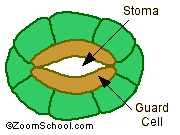
- Cells around the stoma are called guard cells
- store water in vacuole
- Guard cells open and close to protect the stoma
- Osmotic- when there's too much water the water closes the stoma. So then there's less Carbon dioxide.
- Stoma is a fancy name for a whole
- The stoma doesn't absorb the water the guard cells do
- Water and Oxygen go through veins
- When they go through the veins they pass many cells and the water and oxygen go into the cells and some goes through all the way to the top of the plant
- The water wants to go into the cells
Demo:
- The amount of mass is what something weights.
- The mass of the test tube is 50.2 with out the sugar
- The mass with the sugar is 52.7
- The sugar weights 2.5
- The water weights 301
- The water with salt weights 303.3
He have homework today!
Maddie Bedder(BLOG #3)
Thursday, January 6, 2011
01/06/10
Basically we spent all of class debating the answers to the HW
Mr. Finley understands why we are angry at the school website because he is angry too so try to persevere and deal with it:
Suggestions if the HW page appears blank
1 Try logging in...
2 Try calling someone people with working computers...
3 Try restarting your computer...
4 Update all links that you have and make new ones...
On a happier note everyone in this class got 1/2 of a point extra credit for doing their homework!!!!
The HW answers ( If you are still stumped with this HW look at Simrin's HW sheet with the explained hw answers in tonights HW section found )
1 The cell expanded and grew fatter in the cell. Also, the arrows pointed towards the cell. This is because there is less water in the cell and more water outside so osmosis made the water want to go from high concentration to lower concentration.
2 The cell shrunk. There was more water inside the cell too so it went out.
3 The size of the plant cell didn't change because of a cell wall. All three shrunk in the hypertonic and all got bigger in the hypotonic solution.
4 No it couldn't survive because the amount of salt was hypertonic to the amount in the freshwater. So they would shrivel up and get dehydrated in the salty water.
5 You should put the salt on afterwards because if you put it on before the steak will dehydrate and dry out because salt absorbs water because the salt would act like a hypertonic solution of salt so the higher concentration of water in the cell would get out of the cell so the salt could go in.
6 The salad would act like the steak because the salt in the dressing would shrivel because of the salt.
7Same as the above answer accept for weeds. Watch the video for lettuce at the bottom to see what the lettuce looked like after being in the water and what would happen if it went back into water...
Other Notes taken:
For all cells in the hypotonic solution all sucked in water, isotonic stayed the same, and hypertonic got rid of water.
Net movement means the final movement. (Ex. I found $2 and then lost $2 so because I started with nothing I lost $0)
Elodea: Only the insides shrunk also, it only changed size a littlebit because the cell wall was keeping the cell in the same shape. Also, the vacuole was the major thing that shrunk along with the cytoplasm.
For #1 on the HW the amount of water was higher outside but the amount of stuff was hypotonic.
Explanation: http://www.youtube.com/watch?v=AYNwynwaALo
Examples in the kitchen with lettuce and an egg.
Lettuce: http://www.youtube.com/watch?v=H6N1IiJTmnc&feature=related
Egg: http://www.youtube.com/watch?v=0c8acUE9Itw&feature=fvw For this video wait until it's loaded then quickly go through the whole thing because it's pretty long...
KD
(3rd)Wednesday, January 5, 2011
Maria Cordero
Today in class we checked our homework. The answeres were.....
A. was isotonic because it has the same amount as concentration as the plant cell
B. was hypertonic because it had more concentration than the others
C. was hypotonic because it had no concentration.
For part B the answers were.....
A. Was hypertonic because it has 5% stuff on the outside and 2% stuff in the inside
B. Was isotonic because it has 2% stuff on the outside and 2% of stuff inside the cell
C. Was hypertonic because it has 2% stuff in the inside and 0% stuff on the outside.
Then, we did a lab about cellular transport. There is a blood cell, plant cell, and parmeseam cell. Which one is an organism? The parmeaseam cell.
We had to make a graph and answer questions!!! If we didn't finish that was for homework!


A. was isotonic because it has the same amount as concentration as the plant cell
B. was hypertonic because it had more concentration than the others
C. was hypotonic because it had no concentration.
For part B the answers were.....
A. Was hypertonic because it has 5% stuff on the outside and 2% stuff in the inside
B. Was isotonic because it has 2% stuff on the outside and 2% of stuff inside the cell
C. Was hypertonic because it has 2% stuff in the inside and 0% stuff on the outside.
Then, we did a lab about cellular transport. There is a blood cell, plant cell, and parmeseam cell. Which one is an organism? The parmeaseam cell.
We had to make a graph and answer questions!!! If we didn't finish that was for homework!


Tuesday, January 4, 2011
January 4, 2011


In the beginning of class we went over new vocabulary words.(below)
An example of isotonic would be mixing Coke and Pepsi or lemonade mix and water.
Then we had to write up a ice-tea scenario and make up your own example.
WE DO HAVE HOMEWORK!!! CHECK HIS WEBPAGE!!!
kATIE gOMEZ pERIOD 8
Monday, January 3, 2011
Period 8- Concept Map Discussion
 Today in class we changed seats, so that everyone can sit with di
fferent people. We split into groups so that we could get started on our new assignment.
We had to use the words: cell membrane, diffusion, passive transport, osmosis, and concentration. With these words we had to create a concept map, which is basically connecting the words in circles around them, to others that have something in common/or the same general idea.
Beside is a picture of the concept map which the class before helped to create. To sort out everything and to make sure you don't get confused you should remember that:
- Diffusion is the process of molecules spreading, an example of that is when you walk in Hollister towards the cologne section, the scent/molecules spread out in the air.
- Two types of diffusion are passive and active transport.
 Both involve going through a membrane such as the nuclear membrane.
 - Diffusion for active transport occurs from low to high concentration and for passive transport diffusion occurs from high to low concentration
Next, we opened our textbooks to page 60 and 61 to look at active transport again because many people didn't remember what it was. We soon came to a conclusion that:
- Active transport uses energy to produce diffusion so it's like a block or sled going up a hill because it doesn't "want" to go up the hill so it needs energy to do that, it doesn't automatically go up.
- On the other hand passive transport doesn't need or use energy to produce diffusion. So it's like a sled going down a hill. It doesn't try, it goes down automatically. This type of diffusion helps and benefits the cell. Also, when passive transport occurs in water it is known as osmosis. In addition an example of passive transport we have seen is the dye moving if a cheek cell.
Lastly, the main idea is that diffusion reaches an equilibrium, which means the gradient of the molecules is even, and that is a good thing.
Finally at the end of class we shared our concept map and Mr. Finley showed/explained his concept map.
Heads up: WE HAVE NO HOMEWORK
I hope you get a better general idea about diffusion from reading my blog.
--S.K P8
Subscribe to:
Posts (Atom)